Aurora Featured in Case Study: Creating Value Through Carbon Stewardship
Published on Friday, Sep 25, 2026
Aurora’s unique and successful carbon focused business model was featured as a case study in the recent State of Private Investment in Nature 2026 report co-authored by Forest Trends’ Ecosystem Marketplace and The Nature Conservancy. Aurora Sustainable Lands (Aurora) owns and manages approximately 1.6 million acres of forestland across the United States, with over 90% of the current eligible forestland enrolled in carbon projects. The portfolio consists primarily of diverse, naturally regenerating mixed hardwood forests. Aurora’s carbon stewardship management model combines three connected elements: maintaining existing carbon storage capacity across the landscape, supporting continued carbon sequestration through reduced harvest levels and longer tree life cycles, and actively applying climate-adaptive forestry to maintain forest health and resilience as climate conditions change.
Traditionally, private forestland’s financial returns have depended heavily on timber harvests. Aurora was built around a different model: carbon is a primary management and revenue objective, while sustainable timber harvesting and other land uses, including recreation and clean-energy leasing, provide complementary sources of value. Aurora’s ownership structure supports a longer-term approach. Unlike a conventional Timber Investment Management Organization (TIMO) fund termination date, harvest deferrals and stand treatments can be scheduled on a timeline optimal for forest health rather than a disposition timeline. Contracted carbon revenue under long-term offtake agreements gives Aurora the flexibility to absorb temporary dips in local timber markets or localized disturbance events (i.e., a severe ice storm) without accelerating harvests elsewhere in the portfolio, preventing activity-shifting leakage. Aurora still actively manages its forests through sustainable harvests, natural regeneration, forest-health treatments, and climate-adaptive practices designed to respond to pests, disease, wildfire, changing growing conditions, and other disturbances that could weaken forests or release stored carbon.
Aurora’s carbon stewardship model is implemented through Improved Forest Management carbon projects that measure and verify changes in forest carbon stocks over time. Permanently established field inventories, ongoing ground-based and remotely sensed monitoring, and custom-built harvest decision-support tools help connect day-to-day forest management decisions and activities with measurable climate outcomes. Independent third-party verification provides assurance that eligible outcomes have been achieved before credits are issued.
“Carbon revenue can support real practice changes in forest management, including lower harvest levels, longer management horizons, and continued investment in resilient, climate-adapted forests.” -Cakey Worthington, SVP, Sustainability & Natural Capital
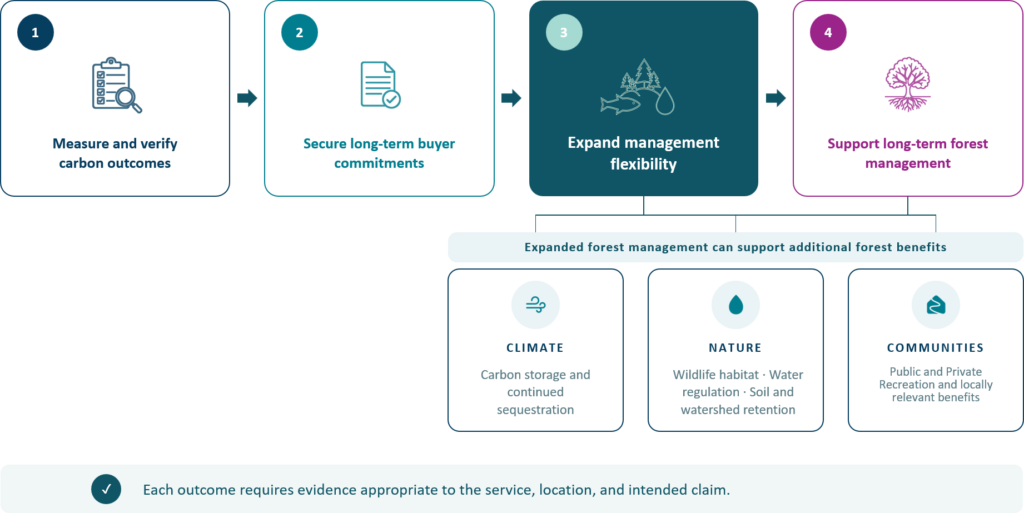
Demand for high-integrity forest carbon credits has enabled Aurora to enter into long-term agreements with major corporate buyers. Publicly announced transactions include an agreement to deliver 4.8 million nature-based carbon removal credits to Microsoft over ten years and a $100 million agreement with TotalEnergies. These longer-term commitments provide more than a market for individual credits: they can offer greater revenue visibility for forest owners making management decisions whose ecological and financial consequences unfold over decades. That wider operational model is what allows Aurora to direct attention toward enhancing additional ecosystem services outside of just carbon sequestration.
Aurora’s lands support critical wildlife habitat, downstream water regulation, soil and sediment retention, a combination of public and private recreation, and other benefits to local communities. Some of these outcomes may support future markets or partnerships, while others remain important outcomes regardless of whether they generate direct revenue.
Aurora’s experience illustrates how recognizing the financial value of carbon can expand the management choices available to forest owners. Carbon stewardship provides a mechanism to support lower harvest levels, climate-adaptive forestry, and long-term investment in resilient forests. The broader lesson is that credible evidence and sustained demand can turn an environmental outcome into a dependable source of support for long-term forest management. See Figure 1.
Figure 1. How carbon stewardship expands forest management choices